
From portfolio to shortlist, in one click
The work does not start in the evaluation. It starts with real locations: properties with photos, sitting on an open map, grouped into projects and portfolios. When you are ready to decide, you push a portfolio straight into an evaluation, and the whole set lands as candidate sites, ready to compare.
That first move matters more than it looks. The candidates are not re-keyed into a fresh spreadsheet or a separate scoring tool. They carry their data with them, because the evaluation lives on the same spine as the locations they came from.
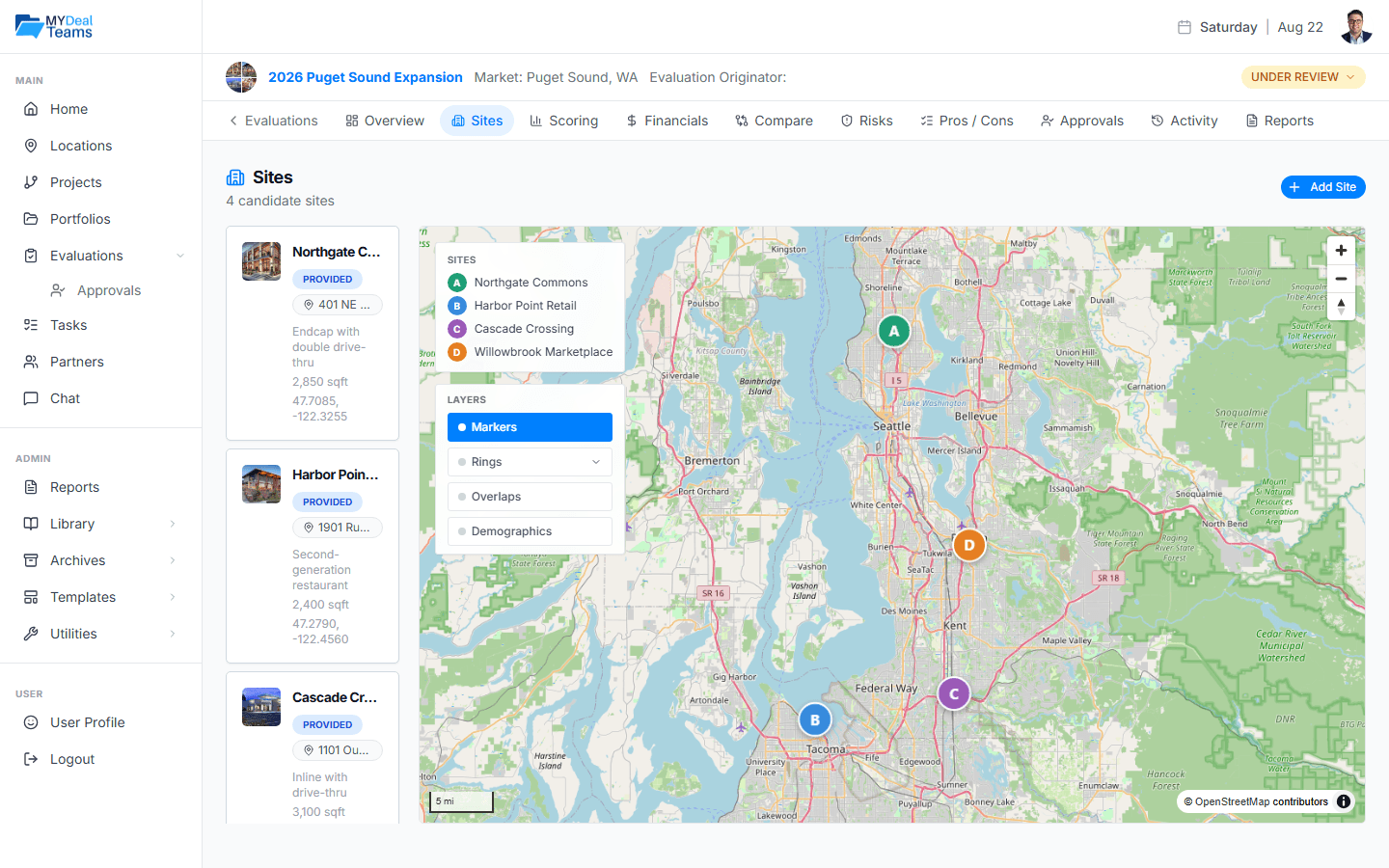
Every candidate on one open map
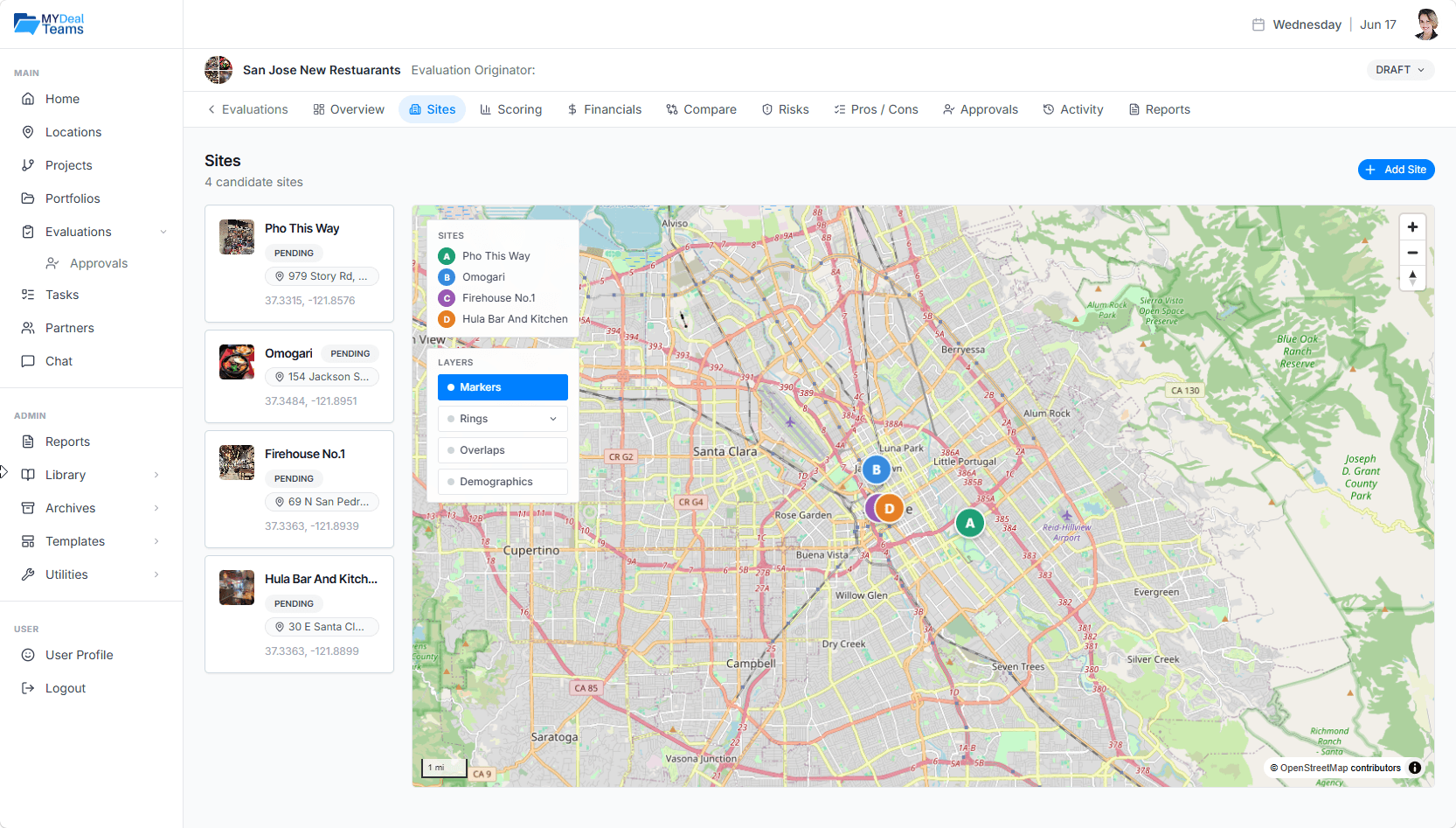
The sites are geocoded and dropped on an open map, with trade areas and demographics built in for each one: population, households, income per household, business counts, employment, keyed to the postal code. There is no Google dependency anywhere in the product, and the demographic data ships with it rather than arriving as a separate subscription you bolt on.
Seeing eight candidates on the same map, with the same data attached to each, is the first time the shortlist stops being a list and starts being a comparison.
The scoring workbench
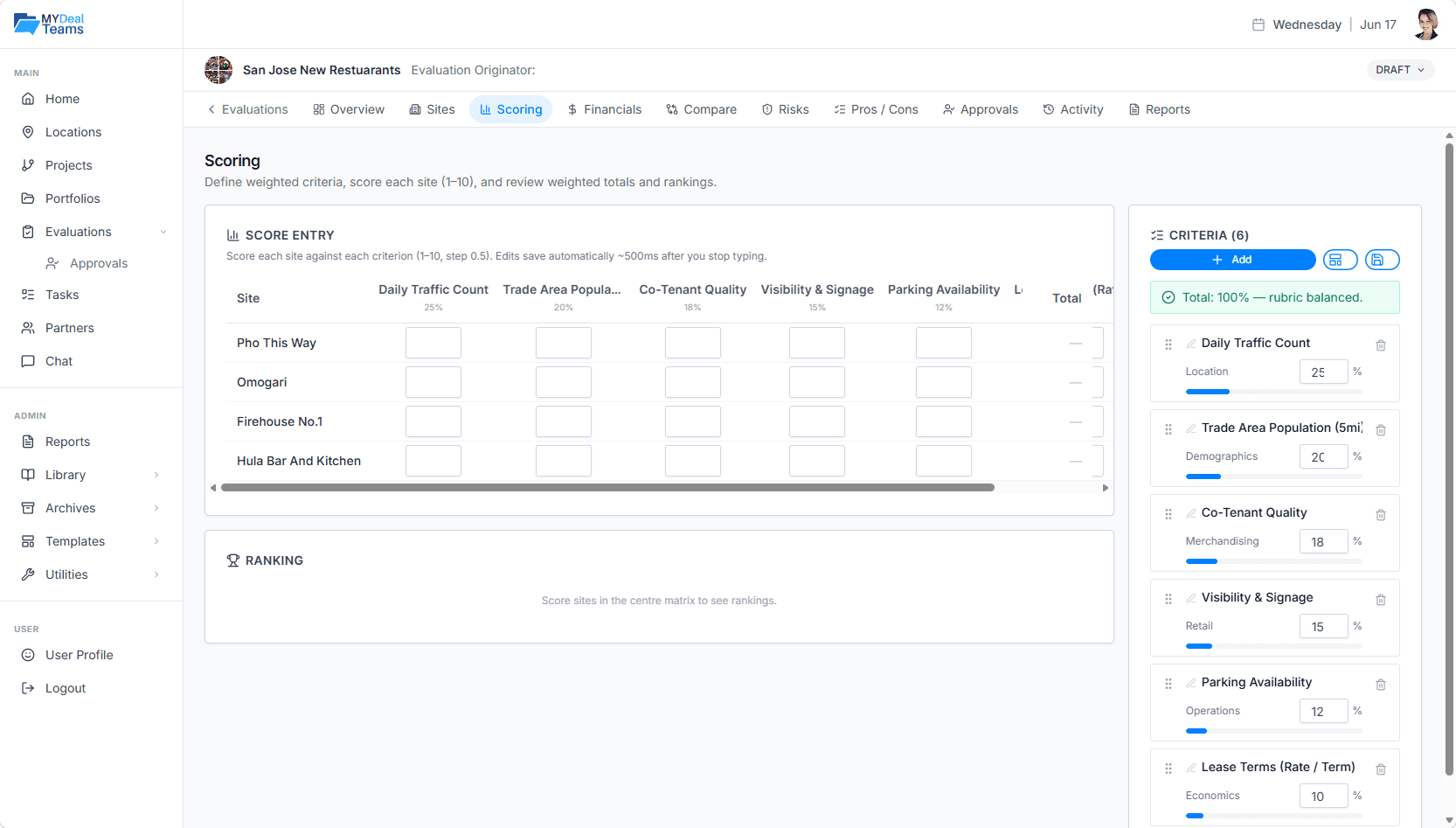
This is the heart of it. On the left, what you care about and what it weighs: daily traffic, co-tenancy, occupancy cost, whatever decides a site for your concept. Starter templates by format (quick-service retail, mid-box, last-mile distribution) give you a set of weighted criteria in seconds, and you tune them to your strategy.
Scores go in the middle, and the ranking on the right updates live as they land. The part that matters most: your whole team scores independently, and the system averages them, so the ranking reflects the team's judgment rather than whoever spoke loudest in the meeting. Add a justification and the reasoning stays attached to the number, which is what makes the decision defensible later.
One spine, not four tools
Here is what the workbench replaces. The typical site-selection stack is one tool for traffic, another for demographics, a spreadsheet for scoring, a map app for visualization, and a final spreadsheet to combine everything. The industry has a name for it now, the duct-tape stack, and the seams between those tools are exactly where the work gets slow and the decision gets hard to defend.
The evaluation runs screening, mapping, weighted scoring, and everything after (underwriting, risk, approvals, reporting) against the same records. Site selection is one tab here, not the whole product. That is the difference between a workbench and a pile of tools on a bench.
The honest version
The workbench does not pick the site for you. Your team still scores it, and your judgment still decides. What the evaluation does is make sure the whole team is looking at the same candidates, on the same map, scored on the same criteria, with the reasoning captured as it happens. In a business where the good boxes have multiple suitors and the committee wants an answer next month, that is the difference between a defensible pick and a fast one you cannot explain.
MyDealTeams is free during Early Access: Community free, Pro $69/month, everything free while we are in Early Access. Nothing to lose, and a deal team to organize.